Building Common Ground — The INT7022 Workshop in Cuba
April 7, 2025
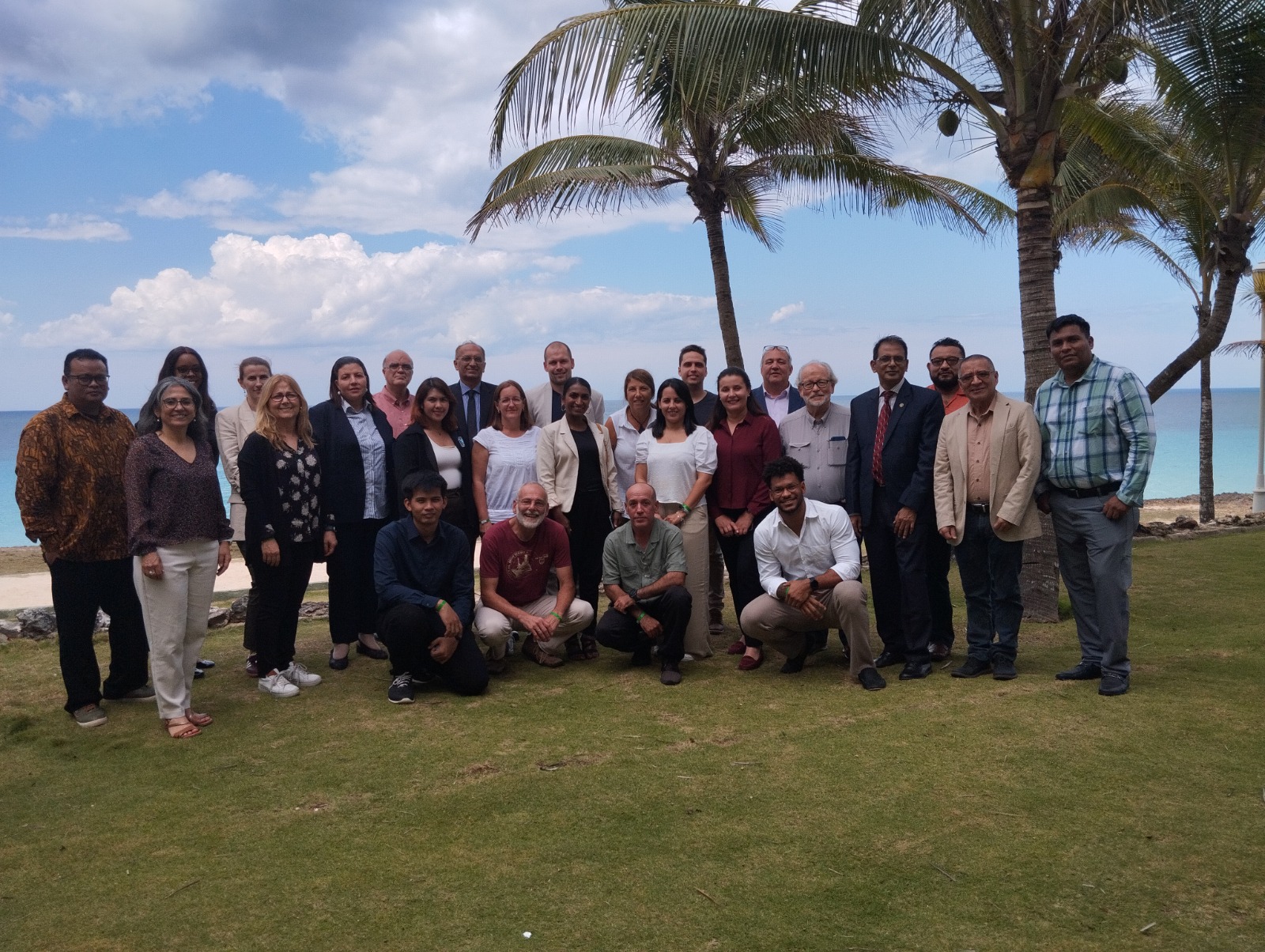
26 scientists from twenty countries.
In March 2025, I had the opportunity to co-organise and attend the workshop of the IAEA Technical Cooperation Project INT7022 — "Strengthening Ocean Health for Sustainable Development: A Global Approach using Nuclear and Isotopic Techniques" — held at the Meliá Varadero Hotel in Cuba from 10 to 14 March 2025.
The five-day workshop brought together twenty scientists from twenty countries: Antigua and Barbuda, Argentina, Bangladesh, Belize, Brazil, Chile, Colombia, Cuba, Ecuador, El Salvador, Indonesia, Kenya, Mauritius, Montenegro, Pakistan, Philippines, Thailand, Tunisia, Türkiye, and Uruguay. Two invited experts, including Dr. Marie-Yasmine Dechraoui Bottein (Université Côte d'Azur, Nice) and Dr. Bernd Krock (Alfred-Wegener-Institute, Bremerhaven), provided technical oversight alongside the IAEA team. The IAEA was represented by Carlos Alonso Hernandez, the Project Technical Officer, and myself as JPO for HABs and Biotoxins.
What the workshop was about
The core objective was deceptively simple: to agree on how to do things the same way. In practice, this meant working through the full monitoring pipeline — from water sampling and organism identification to toxin extraction and analytical reporting — and identifying where protocols diverge across Member States, and why.
Each of the twenty participating countries presented the current state of their national HAB and biotoxin monitoring programme. The diversity was striking: some Member States operate well-resourced laboratories with access to LC-MS/MS instrumentation; others are building programmes from scratch, with limited access to reference materials, trained personnel, or validated methods.
The workshop quickly surfaced two structural bottlenecks that cut across nearly all participating countries.
The first was access to radiolabeled standards for Receptor Binding Assay (RBA) analysis. The RBA is a biologically meaningful, high-throughput technique for detecting paralytic shellfish toxins and ciguatoxins/brevetoxins without requiring live animals, but it depends on tritium-labeled reference standards whose commercial availability is increasingly constrained.
The second bottleneck was the availability of certified reference materials and purified biotoxin standards. Without these, recovery rates cannot be assessed, matrix effects cannot be controlled, and monitoring data cannot be compared across laboratories. Through connections forged at the workshop, the IAEA has initiated dialogue with the biotoxin metrology group at the National Research Council of Canada — a promising avenue for producing materials on a cost-recovery basis if Member States can contribute biological source material.
Sampling protocols: finding consensus
Two full days were dedicated to field sampling methodology, covering both pelagic phytoplankton and benthic organisms relevant to ciguatera risk. Participants were divided into groups based on their primary monitoring interest and tasked with mapping current practice against identified gaps. By the end of the workshop, consensus had been reached on a harmonised benthic sampling protocol, while work on the pelagic protocol continues.
What I took away
Sitting in a room with scientists from twenty countries working through the same monitoring problem from very different starting points is a genuinely clarifying experience. The challenges facing these programmes are not primarily scientific — the methods exist, the knowledge exists — they are institutional, financial, and logistical. The IAEA's role in this landscape is to act as a bridge between what is technically possible and what is practically implementable.
This workshop was a productive first step in that direction. The updated working plan agreed upon in Cuba will guide activities through the remainder of the INT7022 project period (2024–2027), including scientific trainings, expert missions and interlaboratory comparisons, and continued work on reference material access.